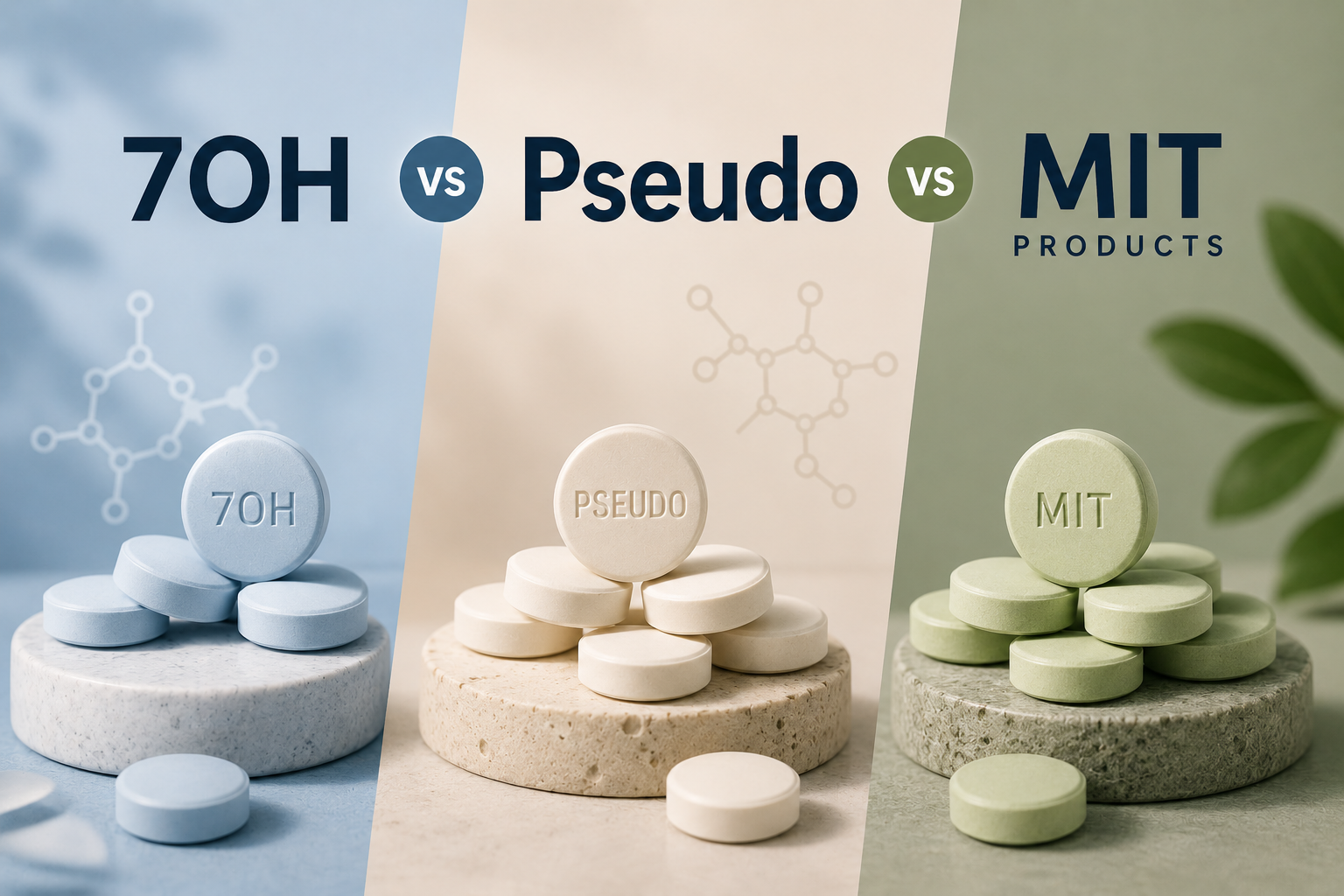

If you have been browsing modern kratom alkaloid products, you have probably seen three terms appear again and again: 7OH, Pseudo, and MIT.
At first, they can sound overly scientific. But for shoppers, the difference matters. These names describe different kratom-related alkaloids or alkaloid derivatives, and they can appear in different types of products, including tablets, shots, gummies, powders, and blended formulas.
This guide breaks down 7OH vs Pseudo vs MIT products in simple language so you can understand what each one means, how they compare, and what to look for before choosing any product.
Important note: This article is for educational purposes only. Products containing 7-hydroxymitragynine, mitragynine, or mitragynine pseudoindoxyl are not FDA-approved to diagnose, treat, cure, or prevent any disease. The FDA has warned consumers about concentrated 7OH products and states that 7OH products have not been proven safe or effective for any use.
Quick Answer: 7OH vs Pseudo vs MIT Products
MIT, short for mitragynine, is the main naturally occurring alkaloid in kratom leaf. 7OH, short for 7-hydroxymitragynine, is a much less abundant alkaloid found in trace amounts in natural kratom but often concentrated in modern products. Pseudo, short for mitragynine pseudoindoxyl, is generally discussed as a metabolite or derivative related to mitragynine and 7OH, and it has recently appeared in specialty alkaloid products.
In practical terms:
|
Product Type |
Best Simple Explanation |
Common Product Positioning |
|
MIT products |
Mitragynine-focused products |
More traditional kratom-style alkaloid profile |
|
7OH products |
7-hydroxymitragynine-focused products |
More concentrated, specialized alkaloid products |
|
Pseudo products |
Mitragynine pseudoindoxyl-focused or blended products |
Advanced or specialty alkaloid formulas |
|
7OH + Pseudo + MIT blends |
Combination formulas |
Designed to combine multiple alkaloids in one product |
What Is MIT?
MIT stands for mitragynine, the primary alkaloid found in kratom leaves. In most kratom discussions, MIT is treated as the “main” alkaloid because it is typically the most abundant compound in the plant.
Many traditional kratom products are MIT-dominant, especially:
- Kratom powder
- Kratom capsules
- Kratom tea
- Basic kratom extracts
- Lower-concentration alkaloid products
7OH.com’s own educational content explains MIT as the primary alkaloid in kratom and describes 7OH as a more potent minor alkaloid that may also form when the body processes mitragynine.
How Are MIT Products Usually Different?
MIT products are often viewed as closer to the natural kratom leaf profile, especially when compared with highly concentrated 7OH or Pseudo formulas.
When reviewing an MIT product, readers should check:
- Total mitragynine content
- Whether it is whole-leaf, extract, or isolate-style
- Serving size
- Third-party lab testing
- State or local shipping restrictions
- Clear warnings and usage instructions
What is 7OH?
7OH stands for 7-hydroxymitragynine. It is associated with kratom but is found naturally only in very small amounts in the plant. FDA materials note that 7OH typically occurs in botanical kratom at about 0.01% to 0.04% by dry weight, depending on the source and material tested.
The big difference is that many modern 7OH products are not simply whole-leaf kratom. They are often concentrated products such as:
- Tablets
- Gummies
- Drink mixes
- Shots
- Enhanced extracts
The FDA has specifically warned about concentrated 7OH products, stating that 7OH is not approved for any medical use and is not lawful as a dietary supplement or when added to conventional foods.
How 7OH Products Are Usually Different?
Compared with MIT products, 7OH products are typically marketed as more concentrated and more specialized.
Before choosing a 7OH product, shoppers should look closely at:
- Milligrams of 7OH per serving
- Number of servings per package
- Whether the product is a tablet, shot, gummy, or powder
- Lab testing and ingredient transparency
- Legal availability in their state or county
- Clear FDA-style disclaimers and warning language
7OH.com’s store structure reflects this product-led browsing behavior, with categories such as Shop By Potency, Shop By Brand, and Shop By Product, including tablets, shots, powders, edibles, gummies, syrups, strips, and more.
What Is Pseudo?
Pseudo usually refers to mitragynine pseudoindoxyl, sometimes shortened as MP or Pseudoindoxyl.
This is where the topic gets more advanced. CFSRE’s NPS Discovery monograph describes mitragynine pseudoindoxyl as a semi-synthetic analogue of mitragynine and also notes that it is a metabolite of mitragynine through 7-hydroxymitragynine and rearrangement.
The United Nations Office on Drugs and Crime also lists mitragynine pseudoindoxyl and notes emerging evidence of products sold with it as the main ingredient or mixed with 7-hydroxymitragynine.
How Pseudo Products Are Usually Different?
Pseudo products are usually positioned as advanced alkaloid products, either on their own or blended with 7OH and/or MIT.
For real shoppers, the key point is this:
Pseudo products should not be treated like basic kratom leaf products. They are part of a newer category of concentrated or specialty alkaloid products, and the available human safety data is limited.
A 2025 study in Drug and Alcohol Dependence identified 304 online products containing 7OH and/or mitragynine pseudoindoxyl; most were 7OH-only, while some were 7OH-MP combinations or MP-only products. The authors noted concerns around high mu-opioid receptor affinity and lack of human safety data for these novel product formulations.
7OH vs Pseudo vs MIT: Side-by-Side Comparison
|
Factor |
MIT Products |
7OH Products |
Pseudo Products |
|
Full Name |
Mitragynine |
7-Hydroxymitragynine |
Mitragynine Pseudoindoxyl |
|
Relationship to Kratom |
Primary kratom alkaloid |
Minor alkaloid found in trace amounts |
Derivative/metabolite related to mitragynine and 7OH |
|
Common Formats |
Powder, capsules, tea, extracts, tablets |
Tablets, shots, gummies, drink mixes, extracts |
Tablets, specialty blends, combination products |
|
Product Positioning |
More traditional kratom-style |
Concentrated, high-potency, specialized |
Advanced/specialty alkaloid category |
|
Buyer Priority |
Alkaloid profile and serving size |
7OH mg per serving and safety transparency |
Clear labeling, lab testing, and ingredient disclosure |
|
Regulatory Attention |
Kratom remains under FDA concern |
FDA has specifically warned against 7OH products |
Emerging monitoring and toxicology attention |
Where Do 7OH + Pseudo + MIT Blends Fit?
Some products combine all three: 7OH, Pseudo, and MIT.
For example, 7OH.com lists Kream 7-OH + Pseudo + MIT Tablets, described as a triple-alkaloid product with 25mg of 7OH, 5mg of Pseudoindoxyl, and 70mg of Mitragynine per tablet.
7OH.com also lists a Kream 7-OH + Pseudo + MIT Shot, described as a 30ml bottle containing 300mg total active alkaloids across three 100mg servings.
These blended products are typically for shoppers who want a product that clearly states its alkaloid mix instead of choosing a single-alkaloid product.
What to Check in a Blend?
Before buying any 7OH + Pseudo + MIT product, check:
This is especially important because products in this category can vary widely in strength and formulation.
Which Product Type Is Right for Which Buyer?
This is not about saying one is “best.” It is about understanding what each product type is designed to represent.
Choose MIT-Focused Products If You Want a More Traditional Alkaloid Profile
MIT products may appeal to shoppers who want something closer to traditional kratom-style products, especially when the product is based on whole-leaf or MIT-dominant extract.
Best fit for:
- People researching classic kratom alkaloid profiles
- Shoppers comparing powder, capsules, or extract products
- Buyers who want MIT-forward labeling
Choose 7OH Products Only If You Understand the Concentration
7OH products are often much more concentrated than standard kratom leaf products. They require extra attention to labels, warnings, and legal availability.
Best fit for:
- Experienced shoppers who understand alkaloid concentration
- People comparing clearly labeled 7OH tablets, shots, or gummies
- Buyers who prioritize transparent milligram labeling
The FDA recommends consumers avoid 7OH products and has described them as novel potent opioid products that have not been proven safe or effective for any use.
Choose Pseudo Products Only With Extra Label Scrutiny
Pseudo products are part of a newer and more specialized product category. Because mitragynine pseudoindoxyl has recently appeared in drug materials and toxicology cases, shoppers should be especially cautious and look for strong transparency.
Best fit for:
- Highly informed shoppers
- People comparing advanced alkaloid formulas
- Buyers who require clear lab testing and ingredient breakdowns
Choose 7OH + Pseudo + MIT Blends If You Want a Multi-Alkaloid Formula
Blends may appeal to shoppers who want one product that combines multiple alkaloids with a clear formula.
Best fit for:
- People comparing combination products
- Shoppers who want precise label breakdowns
- Buyers looking for tablets or shots with clearly stated alkaloid ratios
How to Compare 7OH, Pseudo, and MIT Products Before Buying?
A good product comparison should go beyond price. Here is a practical checklist.
1. Read the Alkaloid Breakdown
Do not stop at the front label. Look for the actual breakdown.
For example:
- How much MIT?
- How much 7OH?
- How much Pseudo?
- Is the amount listed per tablet, per bottle, or per serving?
2. Compare Cost Per Serving, Not Just Product Price
A $29.99 product may be expensive or affordable depending on:
- Number of servings
- Total alkaloid content
- Product format
- Potency per serving
- Whether it is a single-alkaloid or blended formula
3. Check the Product Format
Different formats can create different user expectations.
Common formats include:
- Tablets: portable and easy to portion
- Shots: liquid format, often positioned as convenient
- Gummies/edibles: familiar format but still require careful label reading
- Powders: flexible, but measuring accuracy matters
- Strips or syrups: newer formats that should be checked carefully for serving details
7OH.com’s product navigation includes tablets, shots, powders, edibles, gummies, disposables, syrups, and strips, which makes format-based comparison easier for shoppers.
4. Look for Legal and Shipping Restrictions
Kratom-related products and concentrated alkaloid products may be restricted depending on location.
7OH.com states that certain products are not available for shipment to several U.S. states and specific counties, including Alabama, Arkansas, Indiana, Louisiana, Wisconsin, and listed counties in Florida, California, Illinois, and Mississippi.
5. Avoid Products That Make Medical Claims
Be cautious with any product that claims to treat pain, anxiety, opioid withdrawal, insomnia, or any disease.
A 2025 product-marketing study found that many 7OH and mitragynine pseudoindoxyl products made effect, functional, or drug-related claims; the authors highlighted this as a regulatory and public health concern.
6. Prioritize Transparency
A more trustworthy product page should clearly show:
- Product name
- Product format
- Alkaloid type
- Alkaloid amount
- Serving size
- Ingredients
- Warnings
- Shipping restrictions
- Lab testing information, where available
Common Mistakes Shoppers Make
Mistake 1: Treating 7OH Like Regular Kratom Leaf
7OH occurs naturally in kratom only in trace amounts, while many modern 7OH products contain added or enhanced levels. That makes them meaningfully different from traditional kratom leaf products.
Mistake 2: Ignoring Serving Size
A bottle, tablet pack, or shot may contain multiple servings. Always compare per serving, not just total package strength.
Mistake 3: Assuming “More Alkaloids” Means Better
Higher concentration does not automatically mean a better product. For safety and responsible decision-making, clarity matters more than hype.
Mistake 4: Not Checking Local Laws
Availability can change by state, county, or city. Always check current local rules before ordering.
Mistake 5: Buying Based on Claims Instead of Labels
The best product pages help shoppers understand what is inside the product. Avoid relying only on phrases like “extra strong,” “advanced,” or “fast acting.”
Final Takeaway: Compare the Formula, Not Just the Name
When comparing 7OH vs Pseudo vs MIT products, the most important thing is understanding what is actually in the product.
MIT products are usually closer to traditional kratom alkaloid conversations. 7OH products are more concentrated and have received specific FDA warnings. Pseudo products are newer, more advanced, and should be reviewed carefully. Blended formulas combine multiple alkaloids, making label transparency even more important.
Before choosing any product, slow down and check the alkaloid breakdown, serving size, format, legal availability, and safety disclaimers.
For shoppers who want to compare clearly labeled products by potency, format, and brand, explore 7OH.com’s product categories and review each product page carefully before purchasing.
FAQs About 7OH vs Pseudo vs MIT Products
Q. What does MIT mean in kratom products?
MIT means mitragynine, the primary alkaloid found in kratom leaves. It is the main compound discussed in many traditional kratom products and MIT-focused extracts.
Q. What does 7OH mean?
7OH means 7-hydroxymitragynine, a kratom-related alkaloid found naturally in trace amounts. Concentrated 7OH products are different from standard kratom leaf products and have received specific FDA warnings.
Q. What does Pseudo mean?
Pseudo usually means mitragynine pseudoindoxyl, a mitragynine-related derivative or metabolite that has recently appeared in specialty alkaloid products. CFSRE describes it as a semi-synthetic analogue of mitragynine and notes its emergence in drug products.
Q. Are 7OH, Pseudo, and MIT the same thing?
No. They are related, but they are not the same. MIT is the primary alkaloid in kratom leaf. 7OH is a minor alkaloid and metabolite associated with mitragynine. Pseudo is a related derivative/metabolite discussed in newer alkaloid products.
Q. Are 7OH products FDA-approved?
No. The FDA states there are no FDA-approved drugs containing 7OH and recommends that consumers avoid 7OH products.
Q. What should I check before buying a 7OH, Pseudo, or MIT product?
Check the product format, alkaloid breakdown, serving size, total milligrams, lab testing information, warning language, shipping restrictions, and local legality.
Q. Are blended 7OH + Pseudo + MIT products available?
Yes. Some products combine all three alkaloids. For example, 7OH.com lists Kream 7-OH + Pseudo + MIT Tablets with a stated per-tablet breakdown of 25mg 7OH, 5mg Pseudoindoxyl, and 70mg Mitragynine.